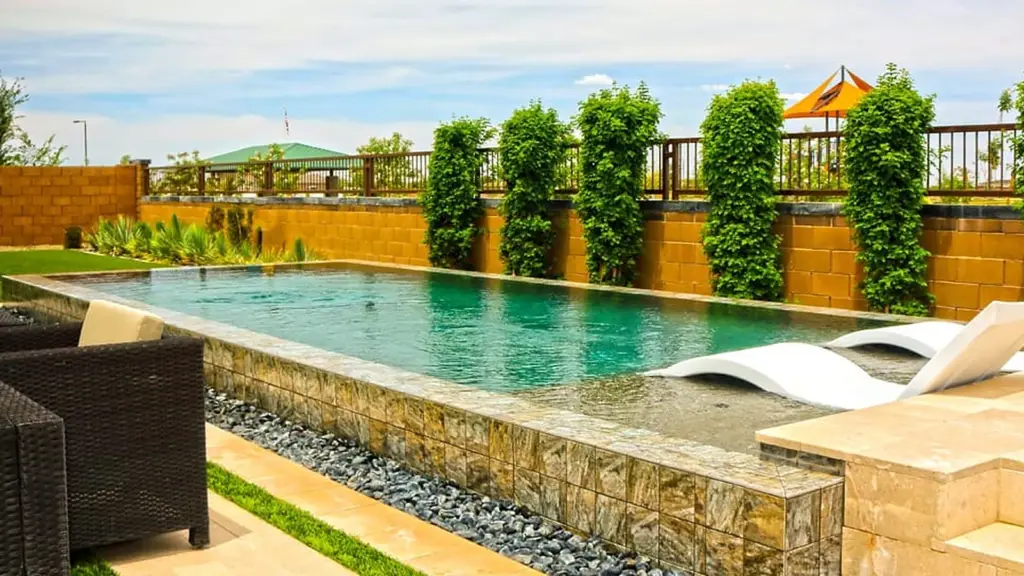
The infinity — or vanishing-edge — pool is one of the most striking designs, and one of the most demanding to engineer. Its beauty lives in details you never see.
When does an infinity pool make sense?
It shines when the pool faces an open view: sea, lake, city skyline or golf course. Surrounded by nearby walls, it won’t deliver the effect.
Key engineering elements
The overflow wall
The edge must be perfectly level along its entire length; even a tiny difference shows up as an uneven waterfall.
Catch basin and balancing tank
Water falls into a basin below the edge and is pumped back into the pool. Its volume must be calculated carefully so it neither overflows when swimmers enter nor runs dry through evaporation.
Design considerations
- Match the finish to the view: deep blue for the sea, grey for a city skyline.
- Orient the edge around the main viewing angle.
- Linear lighting beneath the edge creates a magical night scene.
Cost and upkeep
Infinity pools cost more than traditional ones because of the structure, extra basin and pumps, and they need automatic level control and regular attention to the edge. Built well, though, the pool becomes a work of art that adds real value to the property.